English
 عربى
عربى русский
 简体中文
简体中文







2026-09-24
Home / News / Industry News / Take-Up Winder Spare Parts: Complete Guide to Key Components & Sourcing

On a melt-spinning line running three shifts a day, the take-up winder is under continuous mechanical stress. Spindles accelerate and decelerate thousands of times per shift, traverse mechanisms reverse direction at high frequency, and contact rolls maintain constant pressure against growing packages. Under these conditions, individual components wear, and knowing which parts fail first — and why — is the difference between a planned replacement and an unplanned line stoppage.
This guide covers the key spare parts categories on a take-up winder, explains the function and wear characteristics of each, and outlines what to look for when sourcing replacements for Barmag, TMT, and Chinese-brand winding machines. For background on winder types, speed parameters, and selection criteria, refer to our take-up winder technical guide.
A take-up winder consists of several distinct subsystems — the traverse mechanism, the spindle and chuck assembly, the turret indexing system, the contact roll drive, and the tension control circuit. Each subsystem contains components with different wear rates and replacement intervals. Treating all parts as equally critical leads to either over-stocking slow-wearing components or being caught short on fast-wearing ones.
The practical consequence of an unplanned parts shortage is significant. A single worn shift fork that causes traverse irregularity can produce an entire doff of out-of-spec packages. A failed spindle bearing that causes vibration above threshold will trigger an automatic shutdown across the entire winding position. On a 96-position line, a two-hour unplanned stoppage translates directly to measurable output loss.
Structured spare parts management — knowing which components wear fastest, holding appropriate stock levels, and sourcing from a supplier with reliable lead times — is one of the most cost-effective investments a spinning mill can make in its overall equipment efficiency.
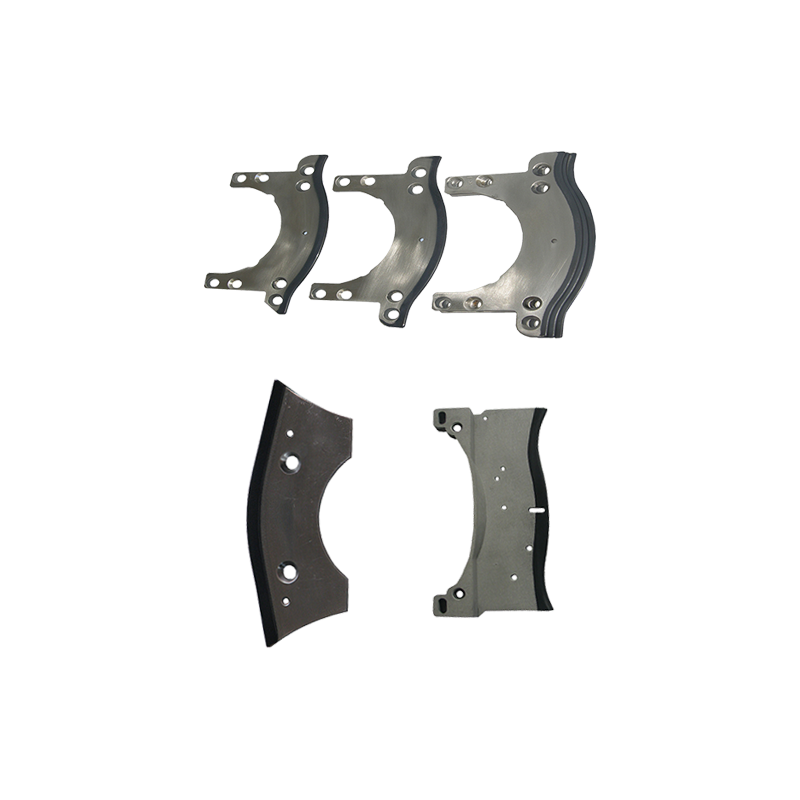
The shift fork — also called a traverse guide fork or grooved drum fork — is the component that makes direct contact with the yarn during the traversing stroke. It reverses direction at high frequency, typically hundreds of times per minute at line speeds above 3,000 m/min, and the contact surfaces are subjected to continuous abrasive wear from the yarn itself.
On Barmag winders, shift forks are categorized by position — RO (right outer), LO (left outer), RU (right under), LU (left under) — and by machine series. Using the wrong orientation causes asymmetric traverse and uneven package build. Groove depth wear beyond the tolerance threshold causes yarn scoring, which introduces tension spikes and increases end-breakage rate. In practice, shift fork inspection should be part of the daily maintenance check on high-speed lines.
Material quality is the primary differentiator between shift fork suppliers. Shengbang uses materials and surface treatments developed and verified through in-house spinning trials, with each batch tested on the company's own spinning laboratory lines before delivery. Shift forks produced for Barmag-platform winders have passed Barmag's own acceptance standards.
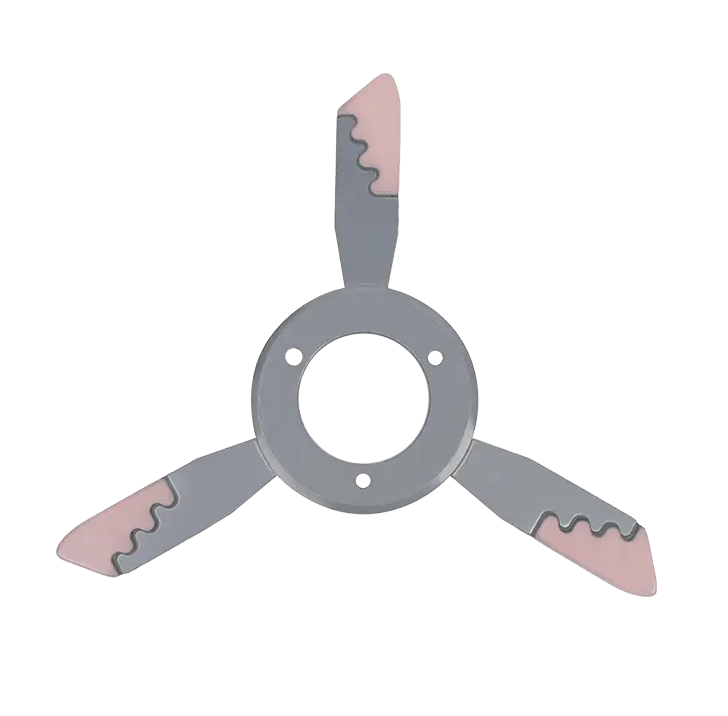
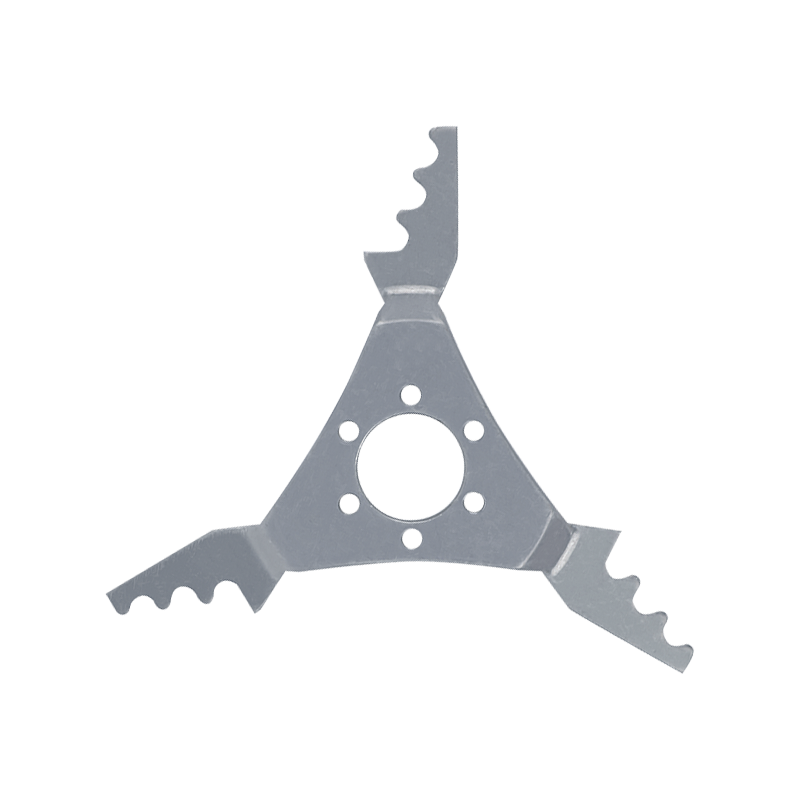
The Y-shaped fork guides the yarn into the traverse zone and works in coordination with the shift fork and grooved drum during the reciprocating motion. Its geometry determines the entry angle of the yarn into the winding position, which directly affects cross-winding angle consistency and package density uniformity.
Modern Barmag winding machines use servo motors with high-precision encoders to synchronize the Y-shaped fork's reciprocating frequency with spindle speed. At these operating conditions, dimensional accuracy of the Y-shaped fork is critical — a deviation in fork geometry translates into traverse ratio error, which is a primary cause of ribbon winding (coil overlay) on POY and FDY packages.
Shengbang's Y-shaped forks are engineered for compatibility with both standard and specialty yarn types including POY, FDY, and composite yarns. The company's spinning laboratory enables testing of fork performance under different yarn denier and speed conditions before field deployment.
Spindle bearings are the highest-precision components on a take-up winder and the most consequential from a quality perspective. At winding speeds of 4,000–7,000 m/min, the spindle rotates at very high RPM under both radial load (from the growing package weight) and axial load (from yarn tension). Any increase in bearing runout above specification causes vibration that translates into package density variation and, at higher severity, end-breakage.
Annual bearing replacement is the standard recommendation on continuously operated high-speed winders. Waiting for audible bearing noise or vibration alarm before replacing spindle bearings is a reactive approach that risks producing out-of-spec packages in the period between early bearing degradation and failure detection.
| Indicator | Normal Range | Replace When |
|---|---|---|
| Spindle runout (TIR) | <0.008 mm | Exceeds 0.008 mm |
| Vibration amplitude | Baseline ± tolerance | Deviation >10% from baseline |
| Operating temperature | Ambient +15–25°C | Sustained rise above normal range |
| Operating hours | — | Annual replacement (scheduled) |
Shengbang manufactures spindle bearing kits for Barmag, TMT, and Chinese-brand winders, authorized under the ESKY bearing standard. Replacement kits are held in stock for same-week domestic dispatch and 5–7 business day international dispatch.
The chuck assembly — comprising the chuck sleeve and chuck base — is the interface between the spindle and the bobbin tube. It must clamp the tube firmly enough to prevent slippage during high-speed winding and acceleration, yet release cleanly and repeatably during automatic doffing.
Chuck sleeve design interacts directly with the push rod fork mechanism and grooved barrel to control how yarn is distributed across the package at the preset winding angle and density. Shengbang has developed chuck sleeve variants that allow the same winding head to handle a broader range of yarn package specifications without requiring a complete tooling changeover — a practical advantage for mills that run multiple product types on the same line.
Chuck base wear typically manifests as inconsistent doff timing or incomplete tube release, both of which cause downstream doffing cycle failures. Inspection of the chuck base for dimensional wear should be part of the monthly maintenance schedule.
Yarn guide rods and yarn guide plates define the thread path from the spin pack to the traverse zone. Their function is straightforward — maintaining a consistent yarn contact angle and preventing lateral deviation — but their condition has a measurable impact on end-breakage rate and yarn surface quality.
Guide wear creates localized grooves on contact surfaces. A groove as shallow as 0.1–0.15 mm can be sufficient to trap finish (spinning oil) and create intermittent tension spikes as the yarn engages and disengages from the groove during traversal. On fine-denier yarns this effect is amplified, making guide condition particularly important on lines producing microfiber or specialty filament.
Plasma-coating of guide surfaces — a process Shengbang performs in-house using equipment from AVIC Manufacturing Technology Institute — significantly extends guide service life compared to uncoated alternatives by producing a surface hardness that resists groove formation even on abrasive high-denier yarns.
Lock rings secure the spindle assembly and maintain correct axial positioning of the chuck relative to the traverse zone. Failure mode is typically gradual loosening rather than sudden fracture, which makes periodic torque checking the correct maintenance approach rather than waiting for a fault condition.
The shift fork gear box translates rotational input from the traverse drive motor into the reciprocating motion of the shift fork. Gear box wear produces increasing backlash in the traverse system, which manifests as softening of the package reversal zone and, at higher wear levels, inconsistent traverse stroke length. Shift fork gear box condition should be evaluated as part of the annual spindle overhaul cycle.
| Component | Typical Replacement Interval | Suggested Min. Stock |
|---|---|---|
| Shift Fork | Daily inspection; replace on wear threshold | 10–15% of total positions per type |
| Y-Shaped Fork | Monthly inspection; replace on geometry deviation | 5–8% of total positions |
| Yarn Guide Rod / Plate | Replace when groove depth >0.15 mm | One full set per machine |
| Tensioning Block | Replace on tension drift detection | 10% of total positions |
| Spindle Bearing Kit | Annual (scheduled) | Full annual replacement quantity |
| Chuck Sleeve | Replace on doff inconsistency | 5% of total positions |
| Lock Ring | Annual torque check; replace if loosening recurs | One set per winder unit |
| Shift Fork Gear Box | Annual assessment; replace on backlash increase | One unit per line |
The spare parts market for Barmag, TMT, and Chinese-brand winders includes OEM suppliers, authorized third-party manufacturers, and a wider range of generic suppliers. Evaluating them on headline specification alone is insufficient — the factors that matter in practice are dimensional accuracy under production conditions, surface treatment quality for wear-critical components, and supply reliability over time.
Jiaxing Shengbang Mechanical Equipment Co., Ltd. manufactures take-up winder spare parts for Barmag, TMT, and Chinese-brand spinning machines from its facility in Jiaxing, Zhejiang Province. The product range covers all major wear components: shift forks (all position variants for Barmag ACW, AW, and WINGS series), Y-shaped forks, spindle bearing kits, chuck sleeves, chuck bases, tensioning blocks, yarn guide rods, yarn guide plates, lock rings, shift fork gear boxes, and aluminum tubes.
Production capabilities include CNC machining, in-house plasma-coating (using equipment from AVIC Manufacturing Technology Institute), and a spinning laboratory where component performance is validated under real operating conditions. Shengbang holds established supply relationships with major Chinese chemical fiber producers including Tongkun Group, Xin Feng Ming Group, Hengli Group, and Shenghong Corp.
Fast-wearing items are held in stock for same-week domestic dispatch. For international customers, standard components ship within 5–7 business days. Custom specifications and large-volume orders are handled by the company's technical sales team, who can advise on part compatibility and optimal stocking quantities for a given line configuration.
To discuss spare parts requirements for your winding line, contact Jiaxing Shengbang Mechanical Equipment Co., Ltd. directly. For detailed information on take-up winder selection, speed parameters, and maintenance schedules, refer to our complete take-up winder technical guide.


ADDRESS: No.1298, Zhouan Road, Economic and Technological Development District, Jiaxing City, Zhejiang Province
PHONE: +86 19057031687
TEL: 86-0573-83777752
EMAIL: [email protected]