English
 عربى
عربى русский
 简体中文
简体中文







2026-10-09
Home / News / Industry News / Barmag Spinning Machine Spare Parts: A Buyer's Guide to Winder, Hot Godet & Other Components

"Barmag spare parts" covers dozens of distinct components across completely different sections of the spinning line — a winder shift fork and a hot godet bearing fail for different reasons, wear on different schedules, and are sourced against different specifications. Ordering the wrong one, or ordering "a bearing" without the position and machine series specified, is one of the most common causes of extended downtime on Barmag POY, FDY, and HOY lines. This guide organizes Barmag spare parts into the three groups that actually matter for sourcing — winder parts, hot godet parts, and other parts — so you can identify what you need before you order, not after the wrong part arrives.
Barmag lines have been installed in multiple generations and series over several decades, and many machines still running in mills today have been reconditioned, retrofitted, or mixed-and-matched over their service life. Two consequences follow.
Treating "Barmag spare parts" as one undifferentiated category is exactly what leads to both problems — stockouts on the parts you actually need on hand, and slow, error-prone ordering for everything else.
The winder is the highest part-count section of a Barmag line, and the section where dimensional accuracy in traversing and bobbin-handling components most directly affects package quality.
| Part | Function | Typical Failure Signs |
|---|---|---|
| Shift Fork | Drives the traverse guide during bobbin transfer / package change | Uneven traverse, package build defects, transfer failures |
| Y-Shaped Fork | Works with the shift mechanism during automatic doffing | Doffing hesitation, incomplete bobbin transfer |
| Shift Fork Gear Box | Drive mechanism actuating the shift fork motion | Erratic or delayed shift timing, unusual drive noise |
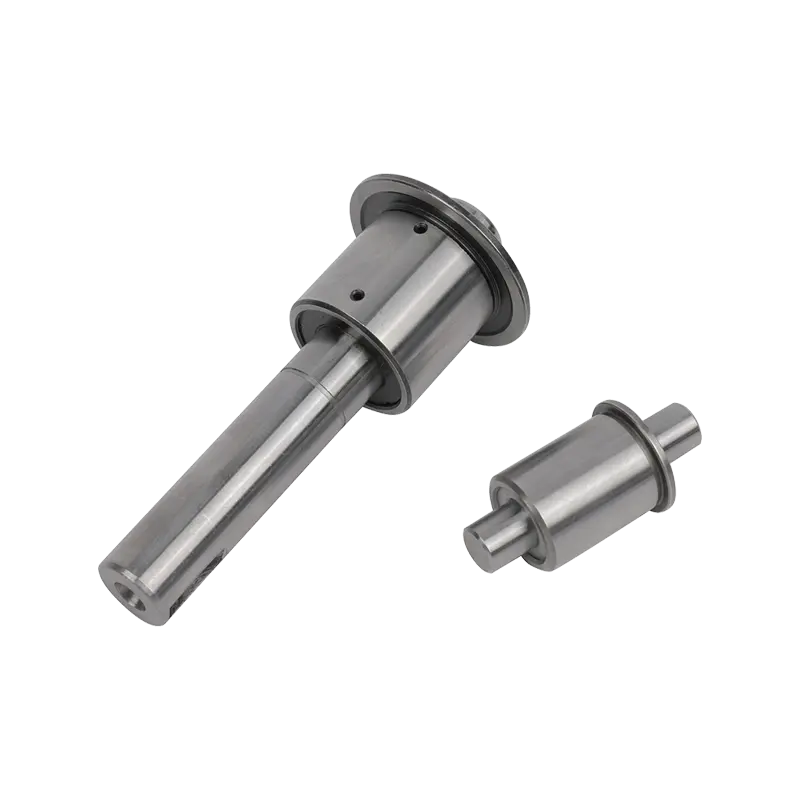
| Bearing | Supports rotating shafts throughout the winder head | Vibration, heat, audible roughness at running speed |
| Lock Ring | Secures the chuck / bobbin holder assembly in position | Bobbin slip, chuck runout, seating looseness |
| Chuck Base / Chuck Sleeve | Holds and drives the winding tube / bobbin | Tube slip, uneven package tension, wear at contact surface |
| Godet | Feed/draw roller controlling yarn speed before winding | Surface wear affecting yarn tension consistency |
| Yarn Guide Rod / Yarn Guide Plate | Direct yarn path into the traverse and package | Grooving / wear marks causing filament abrasion or breaks |
| Tensioning Block | Maintains consistent yarn tension into the package | Package density variation, soft / hard package defects |
| Aluminum Tube | Winding tube / bobbin core | Dimensional wear affecting chuck fit |
Most winder-side failures show up first as a package quality defect — soft ends, ribboning, uneven build — rather than an obvious mechanical fault. Tracing the problem back to the specific worn component, rather than replacing the whole winder head assembly, is usually the faster and lower-cost fix.
Hot godet rollers run at high surface speed and elevated temperature, which puts different demands on their components than the winder side.
| Part | Function | Typical Failure Signs |
|---|---|---|
| Bearing | Supports the heated roller shaft under continuous high-speed, high-temperature operation | Temperature-related premature wear, vibration, bearing noise at operating temperature |
Hot godet bearings are a good example of why generic "bearing" sourcing is risky: a bearing rated for ambient-temperature winder service is not necessarily suitable for continuous operation on a heated godet shaft. Always source hot godet bearings against the godet's actual operating temperature range, not against a general bearing catalog spec.
This group covers components that do not sit in the winder or godet assemblies but are still routinely replaced across a Barmag line.
| Part | Function | Typical Failure Signs |
|---|---|---|
| Interlacing Nozzles | Air-jet intermingling of filaments for yarn cohesion | Inconsistent interlace points, reduced yarn integrity downstream |
| Finish Guide Assembly Plate | Positions the finish / oil applicator relative to the yarn path | Uneven finish application, downstream processing issues |
| Coupling | Connects drive shafts between components | Misalignment, drive vibration, backlash |
| O-ring | Seals fluid / air connections (finish lines, pneumatic circuits) | Leaks, pressure loss in finish or air circuits |
| Rod | Structural / positioning component across various assemblies | Wear at contact points, positional drift |
Note the winder or godet model/series, and the exact position (left/right, upper/lower, spindle number) before requesting a quote. The same part name can differ by position on the same machine.
Where possible, provide the worn part itself, a technical drawing, or clear photos with a scale reference. This is the single fastest way to avoid a dimensional mismatch, especially for winder-side components like shift forks, chuck sleeves, and yarn guide plates where tolerances matter.
Determine whether the part is a routine wear item (O-rings, tensioning blocks, bearings) that should sit in safety stock, or a higher-value, longer-lead item (shift fork gear box, hot godet bearing) that should be planned and ordered ahead of the failure — not after the line stops.
Shift forks, lock rings, and chuck components operate under repeated mechanical load; confirm the material and hardening / heat-treatment spec matches the original rather than assuming "compatible" automatically means equivalent durability.
For high-value, low-failure-tolerance components, OEM or OEM-equivalent sourcing with documented quality control reduces the risk of early failure. For high-turnover consumables (O-rings, common bearings, guide plates), a qualified compatible-parts supplier can meaningfully reduce cost without adding risk — provided material and dimensional specs are verified against the original part.
Barmag spare parts span three practical groups: winder parts (shift forks, bearings, chucks, yarn guides, tensioning blocks, and related traverse/bobbin-handling components), hot godet parts (primarily high-temperature-rated bearings), and other parts (interlacing nozzles, finish guide assembly plates, couplings, O-rings, and structural rods). Sourcing strategy differs by group because operating conditions and failure consequences differ.
Barmag lines exist across multiple generations and series, and many mills run machines that have been reconditioned or retrofitted over time. The same part name can have different dimensions depending on series and position, so specifying the machine series and position — or providing a drawing or the worn part — is the most reliable way to avoid a mismatched part.
Routine wear items with short lead times and predictable failure — O-rings, common bearings, tensioning blocks — are worth keeping in safety stock. Higher-value or longer-lead components — shift fork gear boxes, hot godet bearings — are better planned ahead through condition monitoring rather than stocked in bulk, since they fail less often but cost more to hold as inventory.
For high-turnover consumable parts, a compatible part from a qualified supplier that matches the original material and dimensional spec typically performs reliably at a lower cost. For core load-bearing or precision components, verifying the compatible part's material and heat-treatment spec against the original — not just its dimensions — is the key diligence step before switching away from OEM.
Most winder-side part wear shows up first as a package quality issue — soft ends, ribboning, uneven build, or inconsistent tension — before it shows up as an obvious mechanical fault. Tracing a recurring package defect back to a specific component (tensioning block, yarn guide, chuck) is usually faster and cheaper than replacing an entire assembly.
"Barmag spare parts" is not one sourcing problem — it is three. Treating winder parts, hot godet parts, and other components as a single undifferentiated category leads to stockouts on the parts you need routinely and slow, error-prone ordering on everything else. Identify the machine series and position, classify each part by criticality and lead time, and match your OEM-vs-compatible decision to how much failure risk that specific part can tolerate.
Shengbang manufactures compatible parts across all three groups — winder parts, hot godet parts, and other components — manufactured to match original dimensional and material specifications. Contact our team with your machine series and part reference, and we will confirm fit before you order.

ADDRESS: No.1298, Zhouan Road, Economic and Technological Development District, Jiaxing City, Zhejiang Province
PHONE: +86 19057031687
TEL: 86-0573-83777752
EMAIL: [email protected]