English
 عربى
عربى русский
 简体中文
简体中文







2026-10-09
Home / News / Industry News / PET Chip Drying for Spinning Lines: Moisture Standards, Dryer Types & Selection Guide

Before a single filament of polyester yarn is spun, the PET chips feeding the extruder must be dried to a moisture level far stricter than most processors expect — typically below 40–50 ppm, and often lower for fine-denier or technical yarns. Feed chips at 300 ppm instead of 50 ppm, and the result is not a minor quality dip: it is filament breaks, uneven denier, poor dyeability, and IV loss that can take a spinning line down for hours. This guide covers why PET chip drying is uniquely demanding for spinning applications, the moisture targets by yarn type, dryer technology options, and how to size a dryer for pilot, laboratory, and production spinning lines.
PET (polyethylene terephthalate) is hygroscopic — it continuously absorbs moisture from ambient air, even after a first round of drying. In injection molding or sheet extrusion, a small amount of residual moisture is often tolerable. In melt spinning, it is not, for three reasons.
The practical consequence: spinning lines need chip moisture control that is closer to bottle-grade rPET packaging standards than to general PET processing standards — and they need it maintained consistently, batch after batch, not just on a good day.
The correct drying target depends on what you are spinning. Over-drying wastes energy and cycle time; under-drying shows up as spinning defects you will trace back to the dryer eventually.
| Application | Target Moisture | Typical Consequence If Exceeded |
|---|---|---|
| POY / FDY filament yarn | ≤40–50 ppm | Filament breaks, capillary blockage, denier variation |
| Fine-denier / technical yarn | ≤30–40 ppm | Reduced tenacity, inconsistent draw ratio, spinneret fouling |
| Staple fiber spinning | ≤50–75 ppm | IV drop, brittle fiber, reduced crimp stability |
| Pilot / lab-scale trial spinning | ≤50 ppm (batch-verified) | Unrepresentative trial results, false process conclusions |
| Masterbatch-blended chip (colored yarn) | ≤50 ppm | Color streaking compounded by moisture-driven melt instability |
Because spinning tolerances are tighter than most PET converters realize, a dryer sized for "general PET drying" frequently under-delivers. Specify your yarn type and denier target before selecting dryer capacity and dwell time — not after a batch of unexplained breaks sends you back to the drying step.
Incoming PET chips — whether virgin resin, regrind, or masterbatch-blended chip — typically arrive at 0.2–0.4% moisture from packaging, storage, or ambient exposure during handling. This must be reduced before the chips ever reach the desiccant stage, or the desiccant bed will be overloaded and regenerate too frequently.
This is the core drying stage for spinning-grade chip. Dry air at a dew point of roughly −30°C to −40°C is circulated through a sealed hopper containing the chips, typically at 160–180°C, for 4–6 hours depending on batch size and initial moisture. The desiccant bed (molecular sieve) continuously strips moisture from the circulating air, so the chips are dried by exposure to consistently dry air rather than by raw heat alone — this is what allows the process to reach sub-50 ppm reliably without scorching or discoloring the chip.
For pilot lines, R&D trial runs, and smaller production batches, this stage is usually run in a compact hopper dryer sized to the batch — small enough to dry a representative trial batch without excess chip sitting idle and reabsorbing moisture, large enough to feed a spinning trial or short production run without constant reloading.
Dried chip is hygroscopic the moment it leaves the desiccant hopper. Any exposure to ambient air — an open chute, an unsealed hopper lid, a slow transfer — allows moisture reabsorption that can undo hours of drying in minutes. Spinning lines that get this stage wrong often diagnose the problem as "the dryer isn't working" when the actual cause is unsealed transfer between the dryer and the extruder.
| Dryer Type | Typical Outlet Moisture | Batch Size Range | Best Fit |
|---|---|---|---|
| Ambient hopper / hot-air only | 0.1–0.3% | Varies | General resin storage; not suitable for spinning-grade chip |
| Desiccant hopper dryer (small batch) | ≤50 ppm | 6L / 12L capacity | Pilot spinning trials, lab-scale yarn development, small masterbatch batches |
| Desiccant hopper dryer (mid batch) | ≤50 ppm | 45L capacity | Short production runs, multi-shift pilot lines, sample production for customer qualification |
| Continuous large-scale desiccant system | ≤50 ppm | Line-integrated, continuous feed | High-volume production spinning lines running 24/7 |
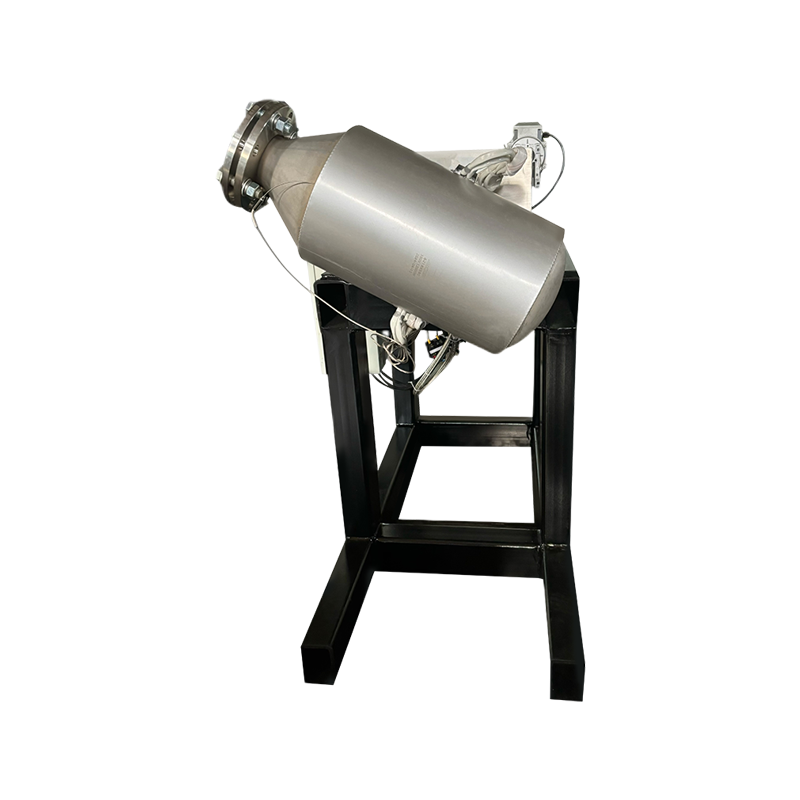
Shengbang's Dryer for Spinning Machine is built around the 6L, 12L, and 45L capacity tiers specifically because pilot and trial spinning work needs chip dried in batches that match trial volume, not oversized industrial hoppers built for continuous 24-hour throughput.
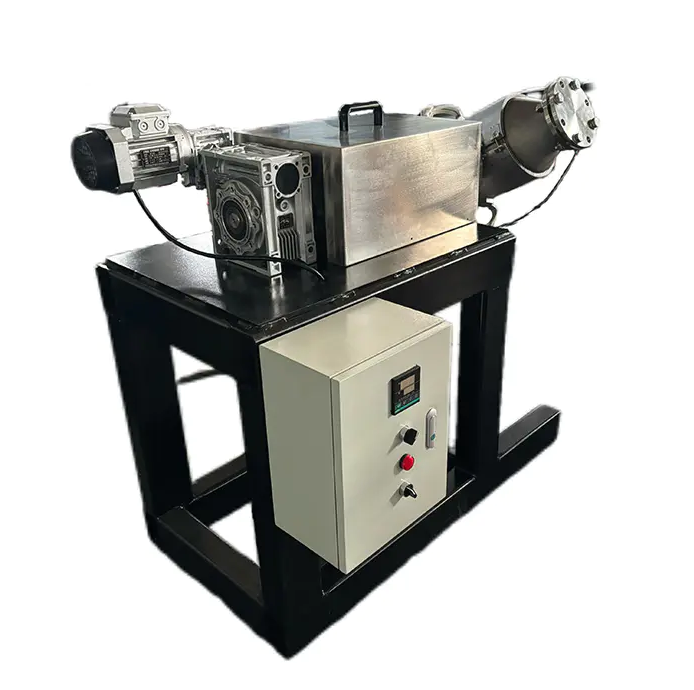
Fine-denier and technical yarns need tighter moisture control than standard staple fiber. Lock this number in before comparing dryer specs.
Oversizing a hopper dryer means chip sits longer than necessary and can begin reabsorbing moisture in transfer zones; undersizing means constant reloading and inconsistent feed to the spinning machine. For lab and pilot work, a 6L or 12L unit is usually the right fit rather than a production-scale system.
A dryer that hits 180°C but circulates air at a poor dew point will not reach sub-50 ppm moisture no matter how long it runs. Ask for the dew point spec at the hopper outlet, not just the inlet.
The best drying result is only as good as the transfer step that follows it. If your line has any open transfer point between the dryer and the feed throat, budget for a sealed or purged transfer solution alongside the dryer itself.
For pilot and qualification work especially, verify actual outlet moisture with a sample check rather than assuming the dryer's rated performance is being achieved in your specific ambient conditions.
Cause: moisture reabsorption during transfer between the dryer and the extruder feed throat. Fix: check for open chutes or unsealed hopper lids; minimize the time chip spends outside the sealed drying environment.
Cause: batch size mismatched to hopper capacity, leading to uneven dwell time. Fix: match hopper size to trial volume — this is one of the most common causes of "the same recipe gave different results" in pilot spinning work.
Cause: moisture-driven melt instability compounding with masterbatch dispersion issues. Fix: confirm chip moisture is at target before troubleshooting the masterbatch or mixing process — drying is often the overlooked first variable.
Most spinning applications require chip moisture below 40–50 ppm, with fine-denier and technical yarns often requiring the lower end of that range. This is tighter than the moisture tolerance for many other PET processes, because spinning temperatures and capillary tolerances leave very little margin for hydrolysis-driven strength loss.
Chip moisture is not visible or detectable by touch — a chip well above the spinning moisture ceiling looks and feels identical to properly dried chip. Filament breaks traced to moisture are almost always confirmed with an actual moisture measurement at the extruder feed throat, not a visual check.
For lab and pilot-scale work, a compact desiccant hopper dryer in the 6L–12L range is typically sufficient to dry a representative trial batch without oversizing the equipment. A 45L capacity suits short production runs or multi-shift pilot operation where reloading a smaller hopper becomes impractical.
Yes, provided the desiccant hopper dryer can reach and hold the required dew point — the drying mechanism is the same regardless of chip source. Recycled or regrind flake may start at a higher initial moisture level, so dwell time may need to be extended slightly to reach the same outlet target.
Indirectly, yes. Moisture-driven hydrolysis and melt instability can compound with masterbatch dispersion issues to produce color streaking or uneven dye uptake. Confirming chip moisture is at target is a standard first troubleshooting step before adjusting masterbatch ratios or mixing parameters.
Spinning-grade PET chip drying is a stricter standard than general PET processing — driven by higher melt temperatures, fine spinneret tolerances, and tight denier and tenacity specs. Getting it right means matching your moisture ceiling to your yarn type, sizing the dryer to your actual batch volume rather than an oversized default, and protecting dried chip through a sealed transfer to the extruder.
Shengbang's Dryer for Spinning Machine is available in 6L, 12L, and 45L capacities to match pilot, laboratory, and short-run production spinning work. Contact our team with your yarn type, denier target, and batch volume, and we will help you match the right drying capacity to your line.

ADDRESS: No.1298, Zhouan Road, Economic and Technological Development District, Jiaxing City, Zhejiang Province
PHONE: +86 19057031687
TEL: 86-0573-83777752
EMAIL: [email protected]