English
 عربى
عربى русский
 简体中文
简体中文







2026-10-09

Bearings are the single most failure-critical components in a Barmag spinning machine. In high-speed winders running continuously at winding speeds above 4,000 m/min, a failed contact roll bearing or chuck shaft bearing can force a full-position shutdown within minutes — and a single unplanned stop on a multi-position FDY or POY line can cost more in wasted yarn and restarting time than a full set of replacement bearings. The direct conclusion is this: selecting the correct Barmag bearing specification, sourcing it from a verified manufacturer, and following a structured maintenance schedule is not an optional best practice — it is the foundation of consistent production line uptime.
This article covers where bearings fit within the Barmag winder and hot godet architecture, how to identify the right part numbers for common Barmag models, the key quality criteria that separate reliable bearings from substandard ones, and a practical maintenance framework drawn from real chemical fiber production environments.
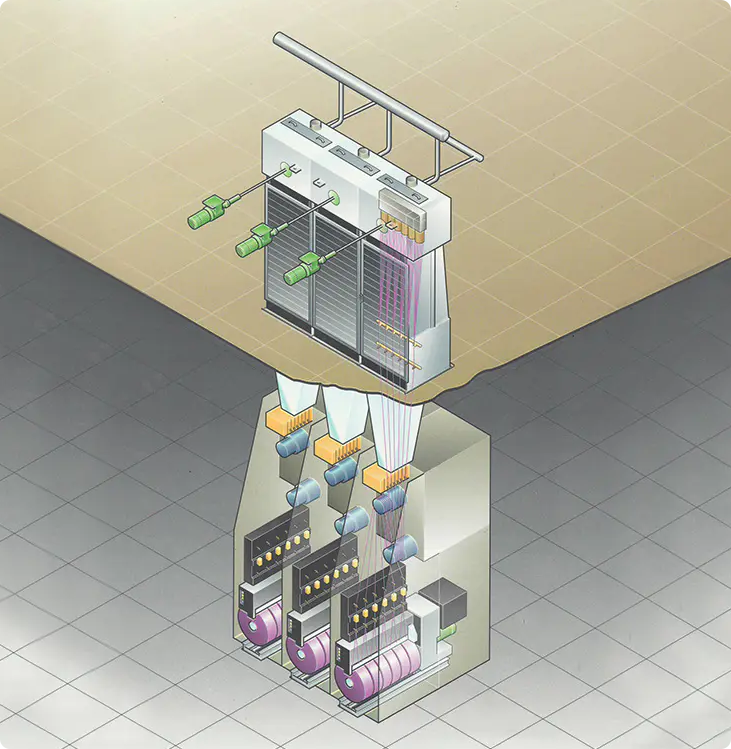
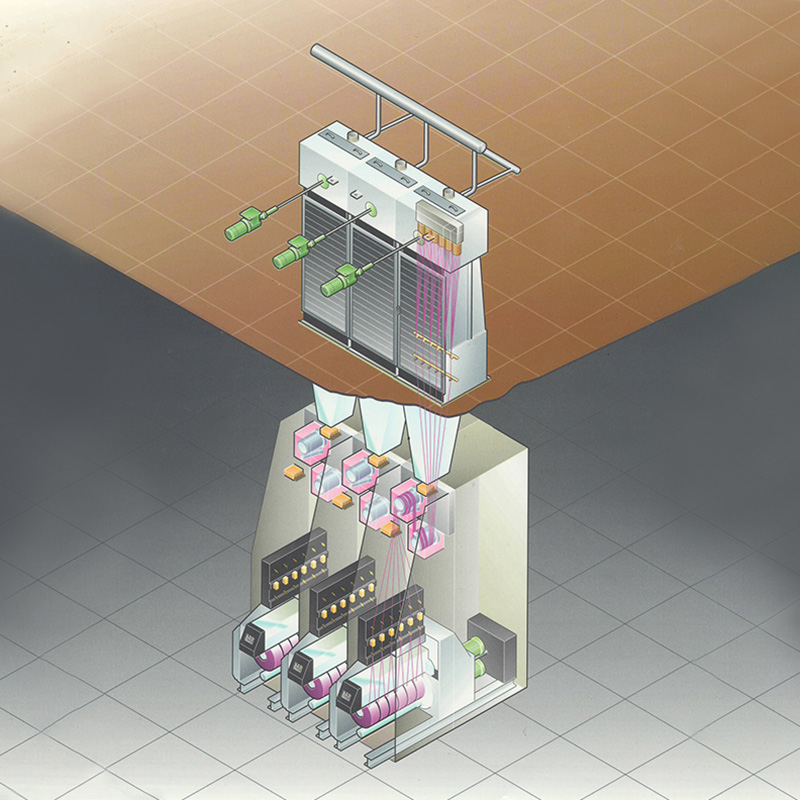
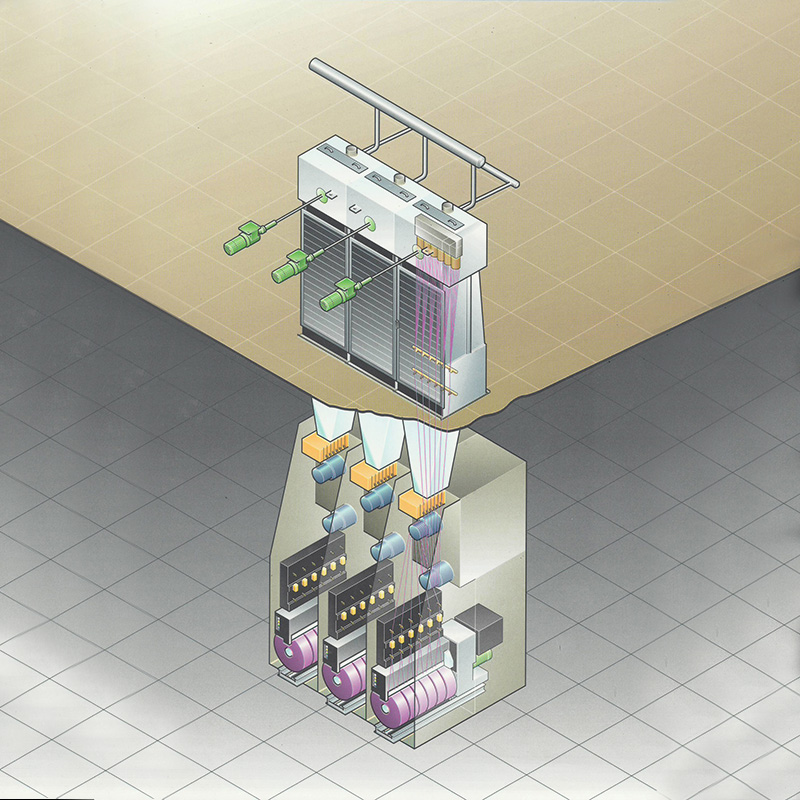
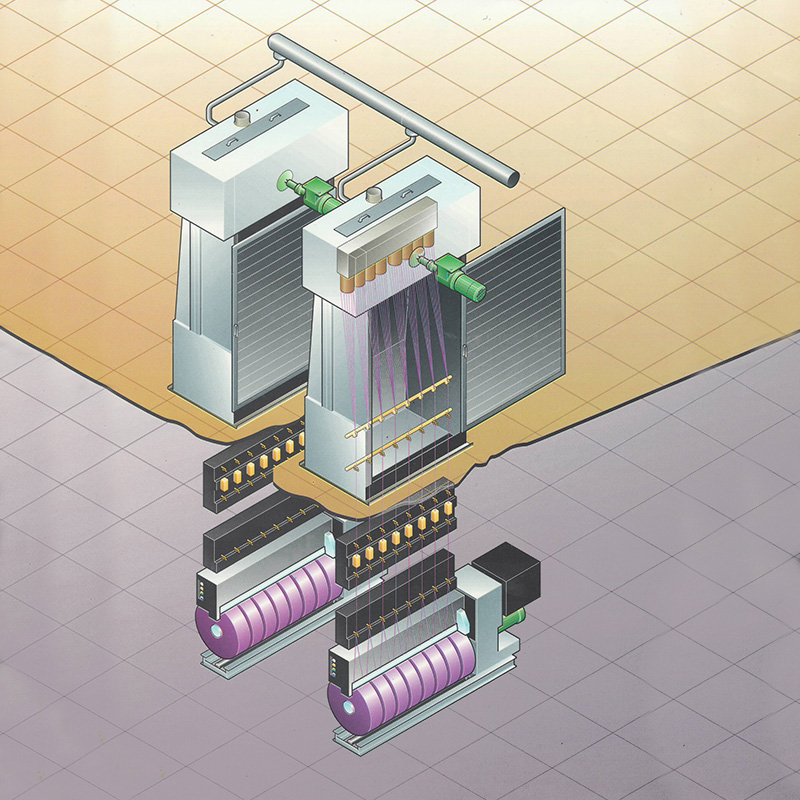
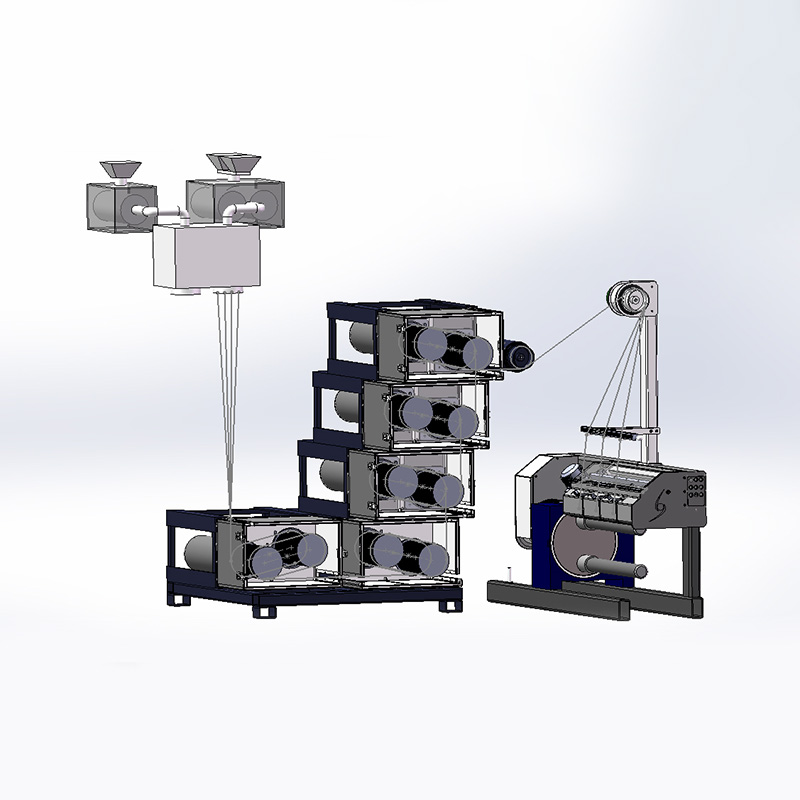
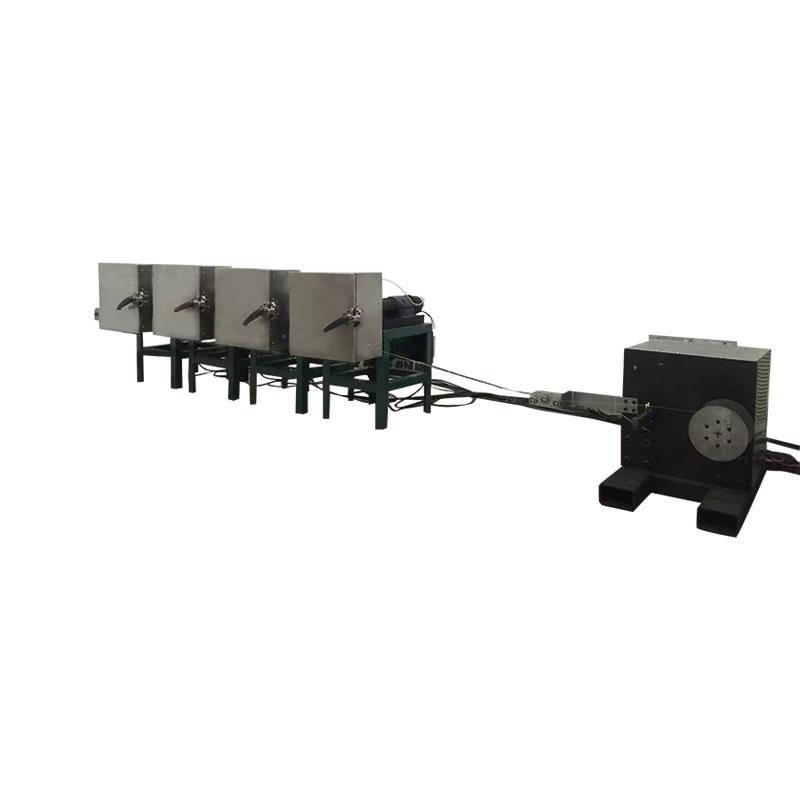
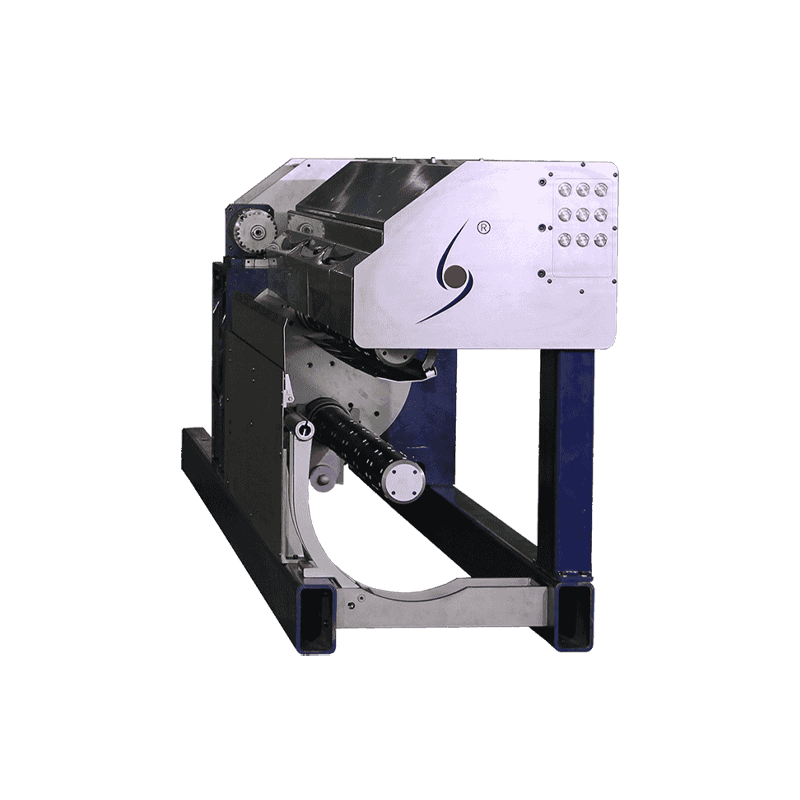
Barmag spinning machines — the winders and godets that form the take-up section of FDY, POY, and HOY chemical fiber lines — use precision bearings in several structurally distinct locations. Each position faces different load types, rotational speeds, and temperature environments, which is why part numbers are not interchangeable between positions even when physical dimensions appear similar.
In the hot godet (draw roll) section that precedes the winder, bearings must operate under combined thermal stress and mechanical load. The godet roller spins at high speed while maintaining surface temperature of 60–220°C depending on yarn type and draw ratio. Hot godet bearings require specific heat-resistant grease formulations and tighter internal clearance grades than ambient-temperature winder bearings — a detail that is frequently overlooked when sourcing replacement parts.
Barmag part numbers encode machine series, assembly group, and production revision. Understanding this structure prevents the most common sourcing mistake: ordering a bearing that fits dimensionally but is specified for a different load class or speed rating. The table below maps commonly required Barmag bearing part numbers to their application positions and key operating context.
| Part Number | Installation Position | Machine Series | Key Operating Demand |
|---|---|---|---|
| 12120500018 | Contact Roll | Standard Barmag Winder | Combined radial + axial load; continuous duty |
| 12120500019 | Contact Roll | Standard Barmag Winder | Higher load variant; used on wider bobbin positions |
| 18091700106 | Contact Roll | Barmag 1800 Series | High-speed 1800 winder; elevated radial stiffness needed |
| 13032300105 | Winder Drivetrain Shaft | Multiple Barmag Models | Moderate speed; primarily radial load |
| 13040900119 | Shift Fork Gear Box | Standard Barmag Winder | Oscillating load; fatigue resistance critical |
| 13040900120 | Shift Fork Gear Box | Standard Barmag Winder | Paired with 13040900119; both replaced together |
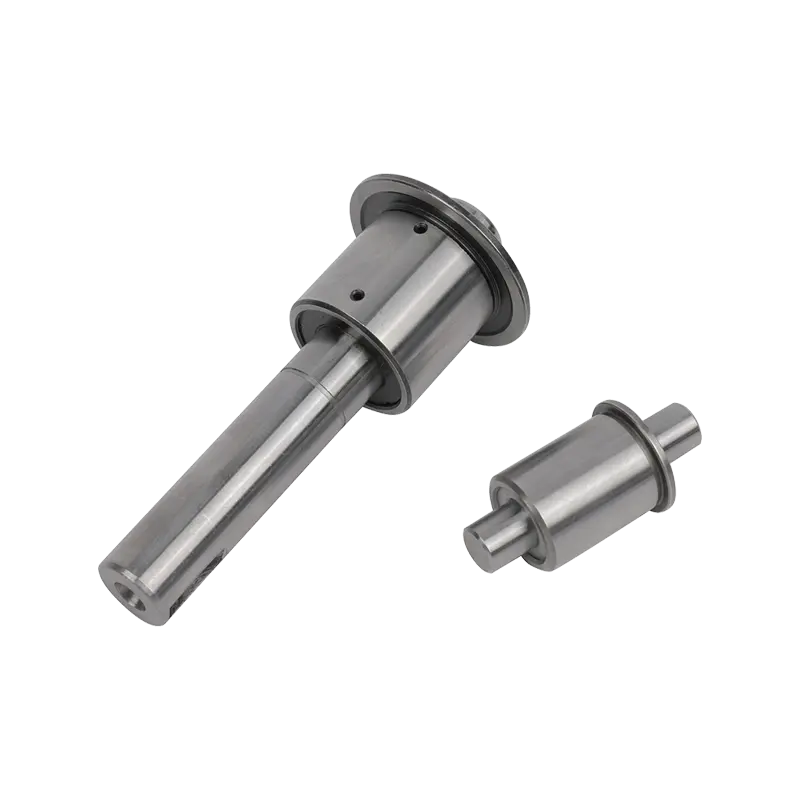
| Shaft Bearing (1380) | Chuck Shaft | Barmag 1380 Chuck | Very high RPM; ultra-low vibration tolerance |
| Shaft Bearing (1600) | Chuck Shaft | Barmag 1600 Chuck | Very high RPM; ultra-low vibration tolerance |
| Shaft Bearing (1800) | Chuck Shaft | Barmag 1800 Chuck | Highest speed rating in the series; tightest clearance grade |
When sourcing replacements, always cross-reference the part number visible on the failed bearing's outer ring markings against the Barmag machine documentation. Part numbers prefixed with the date batch code (e.g., the "1209" in 12120500018 reflects the release date of the design revision) do not indicate manufacturing date — they are design identifiers fixed by Barmag engineering.
Not all bearings with correct dimensions and part numbers deliver equal service life. In chemical fiber spinning, where a single winder may run 24 hours a day for months between planned maintenance stops, the gap between a high-quality bearing and a substandard one can be measured in weeks of additional unplanned downtime per year. The following quality parameters are the most decisive:
Barmag winder bearings operate in housings machined to tight tolerances. For chuck shaft bearings, the required radial runout of the rolling element assembly is typically within 2–3 µm for P5 (ABEC 5) class bearings, and within 1–2 µm for P4 (ABEC 7) class bearings used in the fastest chuck positions. A bearing that meets dimensional specification but fails geometric tolerance will introduce rotor imbalance, increasing vibration at the chuck tip — directly degrading yarn evenness and increasing the risk of yarn breaks.
The rolling elements and raceways of bearings used in Barmag hot godet positions must withstand continuous temperatures up to 220°C without dimensional instability. This requires through-hardened, stabilized bearing steel — typically chrome steel (100Cr6) with high-temperature stabilization treatment that prevents martensitic transformation at elevated temperatures. Bearings without confirmed stabilization treatment will exhibit measurable dimensional growth above 120°C, which increases internal clearance and generates vibration even before visible wear appears.
Barmag specifies different internal clearance grades for different installation positions. Chuck shaft bearings typically require C3 clearance (greater than normal) to accommodate thermal expansion during extended high-speed operation. Contact roll bearings may use normal (CN) clearance. Installing a C3-specified bearing in a CN position — or vice versa — is a silent fault: the machine starts without error, but bearing life falls to a fraction of expected, often failing within weeks rather than months.
High-speed chuck bearings use brass or polymer cages designed for low noise and stable grease retention at high centrifugal loads. The pre-packed grease must have a dropping point above 200°C (typically a lithium complex or polyurea grease) and must be compatible with any additional grease applied during installation. Mixing incompatible grease types causes saponification — a chemical reaction that destroys the lubricant film and rapidly accelerates wear.
All bearings from verified Barmag parts suppliers should have passed practical application tests in actual chemical fiber spinning environments before commercial release — not just laboratory test-bench certification.
Bearing degradation in a Barmag winder rarely presents as a sudden catastrophic failure. In most cases, it follows a detectable progression that gives operators a window to schedule replacement before unplanned shutdown — provided they know the warning signs.
The following maintenance schedule reflects practical intervals used in continuous chemical fiber production. Actual intervals should be adjusted based on vibration monitoring data and the specific Barmag machine model.
| Interval | Action | Target Bearing Position | Acceptance Criterion |
|---|---|---|---|
| Daily | Infrared temperature spot-check | Chuck shaft, contact roll, godet | Within ±5°C of baseline; flag if >10°C rise |
| Weekly | Vibration measurement at housing | Chuck shaft bearing, contact roll bearing | ≤4.5 mm/s RMS; schedule inspection if exceeded |
| Monthly | Grease replenishment (if not sealed-for-life) | Shift fork gearbox bearings | Add correct grease type; do not exceed 1/3 housing volume |
| Every 3–6 months | Bearing inspection and clearance check | All winder bearing positions | No visible pitting, spalling, or discoloration; clearance within spec |
| Annual overhaul | Planned replacement of high-load bearings | Chuck shaft bearings, contact roll bearings | Replace regardless of apparent condition; document lot numbers |
| On condition | Immediate replacement on vibration alarm | Any position exceeding vibration threshold | Replace within planned maintenance window, not next quarterly stop |
One practical note on godet bearing replacement: hot godet bearings should always be replaced as a matched pair (both bearings supporting one godet roller at the same time), even if only one shows wear. The uneven load sharing that results from replacing a single bearing in a two-bearing godet mount accelerates degradation of the new bearing to match the wear state of the retained old one — negating the benefit of the replacement within weeks.
The choice between original Barmag-branded bearings and high-quality compatible parts is a cost-performance decision that varies by bearing position and production criticality. The following framework reflects how experienced chemical fiber maintenance teams approach it:
The key qualifier for any compatible bearing is that it must have been validated through actual chemical fiber production testing — not just dimensional inspection against the OEM part. Manufacturers who supply parts directly to major chemical fiber groups (such as Tongkun Group, Hengli Group, or Shenghong Corp.) and whose parts survive in those production environments provide a practical guarantee that dimensional and material specifications translate to real-world service life.
The inventory classification that minimizes both cost and risk is to maintain a safety stock of at least two chuck shaft bearings and two contact roll bearings per winder (Class A parts: high value, long lead time if sourced from OEM channels), and to stock five or more units of shift fork gearbox bearings and general shaft bearings (Class B and C parts: shorter lead times, lower per-unit cost) for routine planned replacement.
Even a perfectly specified, high-quality bearing will fail prematurely if installed incorrectly. Installation errors are the second most common cause of early Barmag bearing failure after incorrect part selection, and they produce failure patterns that can be mistaken for manufacturing defects in the bearing itself.
Overall Equipment Effectiveness (OEE) — the combined measure of availability, performance, and quality rate — is the standard metric for quantifying the business impact of maintenance decisions on a chemical fiber spinning line. Bearing condition affects all three components of OEE simultaneously:
Production lines that implement vibration-based condition monitoring for Barmag bearings, combined with planned annual replacement of high-load bearing positions and verified-quality compatible parts for moderate-duty positions, consistently achieve OEE above 85% — a result primarily attributable to the reduction in unplanned bearing-related downtime rather than any other single maintenance improvement.

ADDRESS: No.1298, Zhouan Road, Economic and Technological Development District, Jiaxing City, Zhejiang Province
PHONE: +86 19057031687
TEL: 86-0573-83777752
EMAIL: [email protected]