
 English
 عربى
 русский
 简体中文








A practical engineering guide to selecting, reconditioning, and operating a second-hand spinning machine—covering used Barmag spinning equipment, raw material compatibility, melt spinning workflows, and preventive maintenance.
As global chemical fiber producers balance rapid capacity expansion with strict capital expenditure limits, sourcing a second-hand spinning machine has shifted from a budget compromise to a calculated engineering strategy. Whether expanding a polyester filament line or retrofitting an existing workshop, acquiring a properly reconditioned second-hand spinning machine cuts upfront capital costs by 40% to 65% while compressing delivery lead times from over a year to under three months. However, evaluating used Barmag spinning equipment or TMT production lines requires rigorous inspection of mechanical tolerances, thermal uniformity, and spare parts continuity rather than simple visual checks.
1. Core Technical Parameters for Reconditioned Melt Spinning Lines
When auditing a second-hand spinning machine for POY (Partially Oriented Yarn), FDY (Fully Drawn Yarn), or HOY (High Oriented Yarn) production, procurement engineers must verify baseline mechanical and thermal specifications against OEM standards. Deviation in rotational balance or surface temperature directly degrades yarn tenacity, elongation, and dye uptake uniformity.
| Sub-System / Parameter | Typical OEM / Reconditioned Benchmark | Critical Inspection & Calibration Standard |
|---|---|---|
| Take-Up Winder (e.g., Barmag ACW / TMT Series) | Winding speed: 2,500 – 6,000 m/min; Chuck length: 1,200 – 1,500 mm (8 to 12 ends) | Dynamic balancing on German SCHENCK machines; chuck runout < 0.015 mm; zero traverse gearbox backlash |
| Hot Godet Rollers (Drawing & Heat Setting) | Operating temperature: 80°C – 240°C; Speed: up to 6,000 m/min | Multi-zone induction heating accuracy within ±1.0°C (Barmag temperature calibration standard); plasma-coated ceramic/chrome surface roughness (Ra 0.2–0.8 μm) |
| Extruder & Spinning Beam | Screw L/D ratio: 28:1 – 32:1; Dowtherm / biphenyl vapor heating at 280°C – 310°C | Barrel wear clearance < 0.15 mm; beam temperature uniformity within ±1.5°C across all spinning positions |
| Metering Pumps & Spinning Packs | Output range: 0.6 – 10 cc/rev per stream; Pressure rating up to 350 bar | Volumetric efficiency > 98%; zero leakage at pack sealing surfaces; OEM-grade spinneret capillary precision |
| Control & Drive Architecture | Closed-loop inverter drive; synchronized PLC & HMI control panel | Speed synchronization accuracy ±0.02%; full parameter retention and alarm diagnostics |
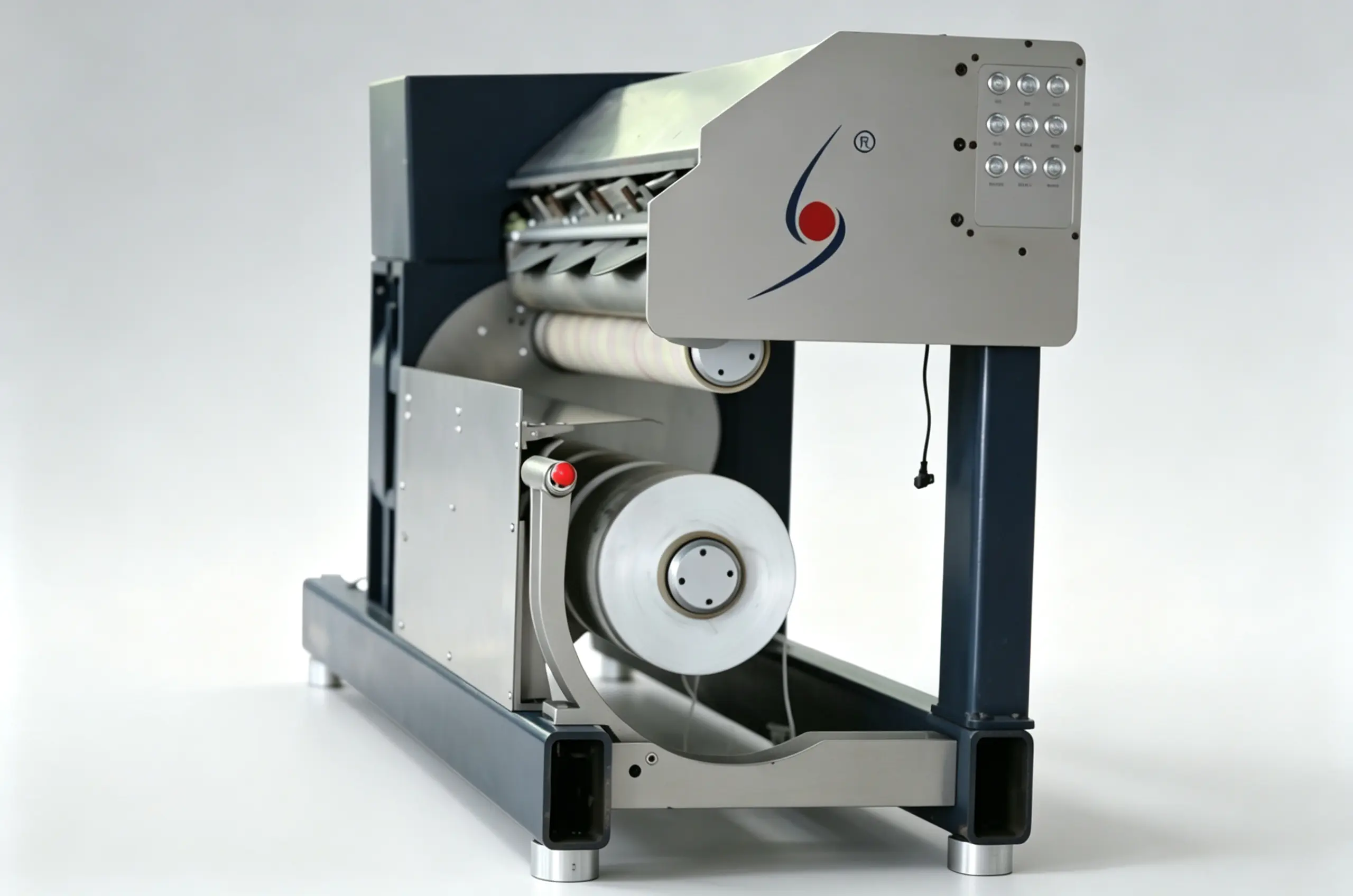
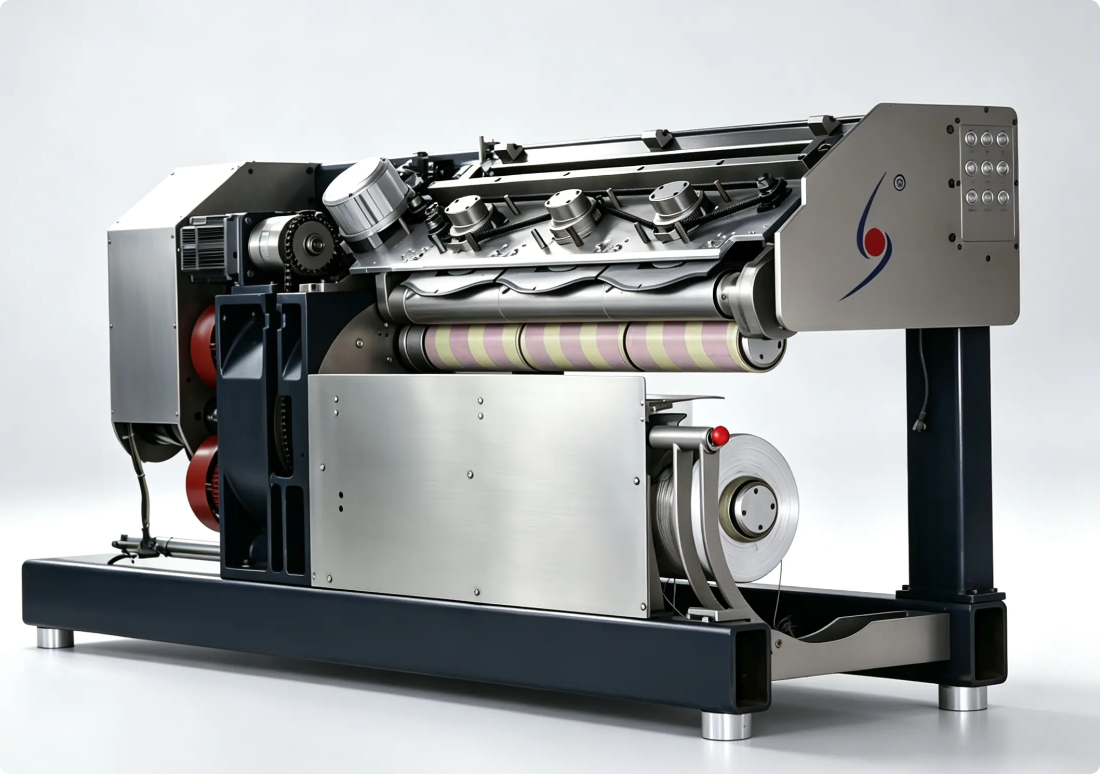
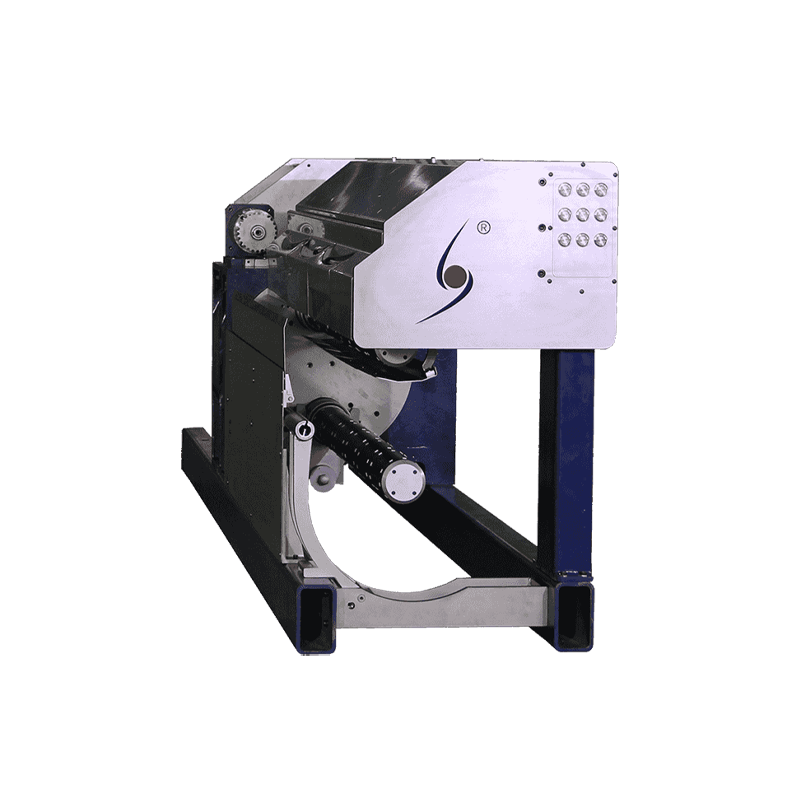
For buyers evaluating used Barmag spinning equipment (ACW series), special attention must be paid to the high-speed chuck bearings, rotary traverse shift forks, and godet shell coatings. Worn plasma coatings increase yarn-to-roller friction, causing broken filaments and uneven shrinkage during downstream texturing.
2. Raw Material Characteristics and Equipment Adaptability
A common mistake when purchasing pre-owned chemical fiber machinery is assuming a production line configured for virgin PET can run recycled PET (rPET) or Polyamide (PA6/PA66) without hardware modifications. Each polymer exhibits distinct rheological and thermal behaviors that dictate machine setup:
- Virgin PET (Polyethylene Terephthalate): Requires intrinsic viscosity (IV) between 0.62 and 0.68 dL/g for apparel-grade POY/FDY. Because PET is highly sensitive to hydrolytic degradation at melt temperatures (285°C–295°C), the upstream crystallization and drying system must consistently reduce chip moisture below 30 ppm.
- Recycled PET (rPET Flakes / Chips): Exhibits broader molecular weight distribution, higher contamination risk, and fluctuating IV values. Running rPET on a reconditioned spinning line requires upgraded continuous screen changers (backflush filtration), reinforced screw geometry to stabilize melt pressure, and slightly lower extrusion temperatures to prevent thermal chain scission.
- Polyamide 6 & Polyamide 66 (PA6 / PA66): Demands strict oxygen exclusion during melting (nitrogen blanketing in the hopper) to prevent oxidative yellowing and gel formation. PA66 melts at approximately 260°C–265°C with lower melt viscosity than PET, requiring tighter clearances in planetary metering pumps and specialized spin finish applicators.
- Polypropylene (PP): Processed at lower temperatures (210°C–250°C) without pre-drying, as PP is hydrophobic. However, PP exhibits pronounced die swell and requires extended quench air zones and tailored godet draw ratios to achieve target tenacity.
3. End-to-End Melt Spinning Process Flow on Reconditioned Lines
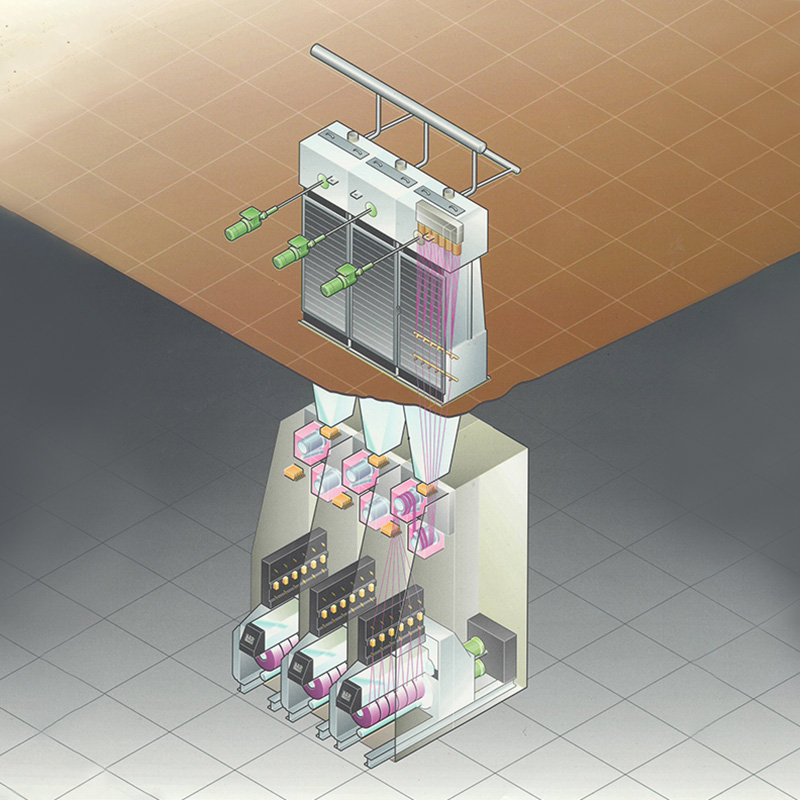
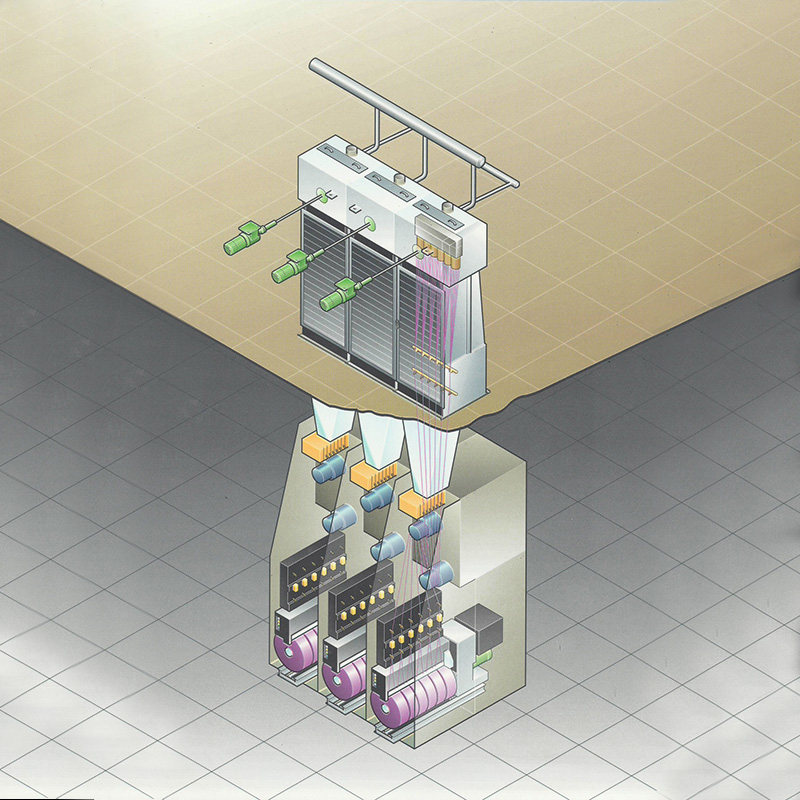
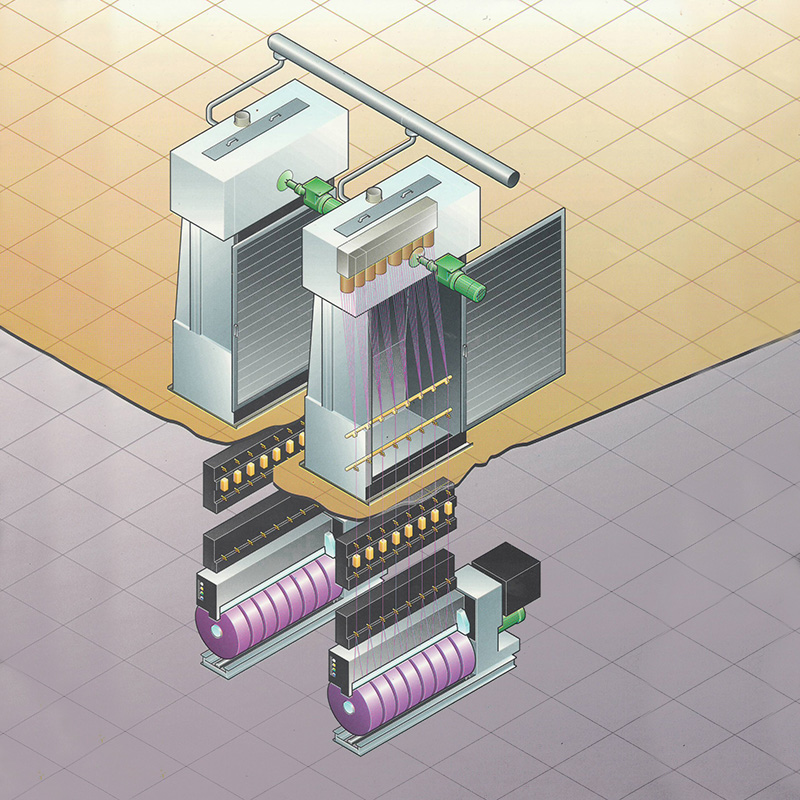
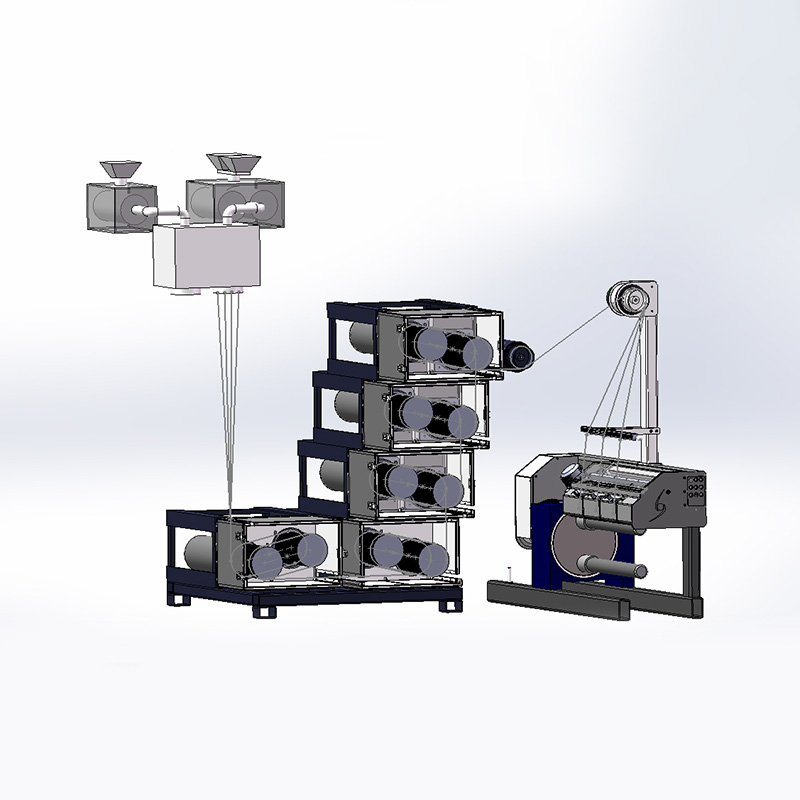
Understanding how reconditioned modules interact across the production workflow ensures seamless integration into existing plant layouts. A standard POY/FDY melt spinning line operates across six synchronized stages:
- Polymer Drying & Crystallization: Hygroscopic chips (PET, rPET, PA) pass through a pre-crystallizer and dehumidifying drying tower (dew point -40°C or lower) for 4 to 6 hours to prevent viscosity drop during extrusion.
- Melt Extrusion & Filtration: Dried chips enter a single-screw extruder where shear heat and barrel heaters convert solid polymer into a homogeneous melt. A duplex candle filter or continuous screen changer removes solid impurities before the melt enters the manifold.
- Spinning Beam & Metering: The biphenyl-heated spinning beam distributes polymer equally to each spinning position. High-precision gear metering pumps deliver an exact volumetric flow rate to the spinning packs, forcing melt through microscopic spinneret capillaries.
- Quench Air Cooling & Spin Finish Application: Emerging molten filaments pass through a cross-flow or radial quench chamber with laminar conditioned air (18°C–24°C, 65%–75% RH) to solidify uniformly. An oiling guide or roller then applies spin finish emulsion (0.4%–1.2% oil pickup) to provide antistatic protection and inter-filament cohesion.
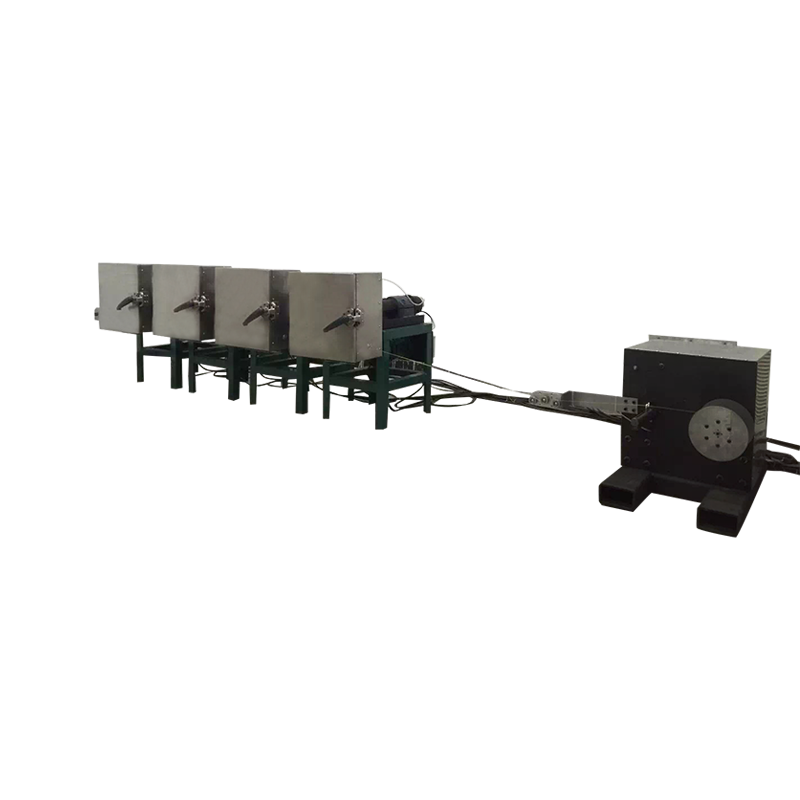
- Drawing & Heat Setting (FDY vs. POY): In a POY line, filaments pass over two cold or slightly heated godets before winding at 2,800–3,500 m/min. In an FDY line, filaments undergo multi-stage hot drawing between heated godet pairs (Draw Roll 1 at 85°C–95°C; Draw Roll 2 at 120°C–140°C) to orient crystalline structures before high-speed take-up.
- High-Speed Automatic Take-Up Winding: An interlacing nozzle imparts controlled air-jet tangling knots (10–25 knots/meter) to maintain bundle integrity, followed by automatic turret-switching winders (such as Barmag ACW or TMT models) that build precision cross-wound bobbins up to 15–20 kg.
4. Selection Logic: How to Source a Second-Hand Spinning Machine Safely
Navigating the secondary textile machinery market requires structured technical due diligence. Procurement and engineering teams should evaluate prospective suppliers against five core selection criteria:
Verify In-House Reconditioning Infrastructure
Avoid pure brokers who sell equipment "as-is" from shuttered mills without mechanical overhaul. A qualified reconditioning manufacturer must possess dedicated CNC machining workshops, dynamic balancing instruments (such as German SCHENCK balancers for winder chucks and godets), aerospace-grade plasma spray coating facilities for roller surface restoration, and OEM-calibrated thermal testing rigs.
Audit Spare Parts Stock & Interchangeability
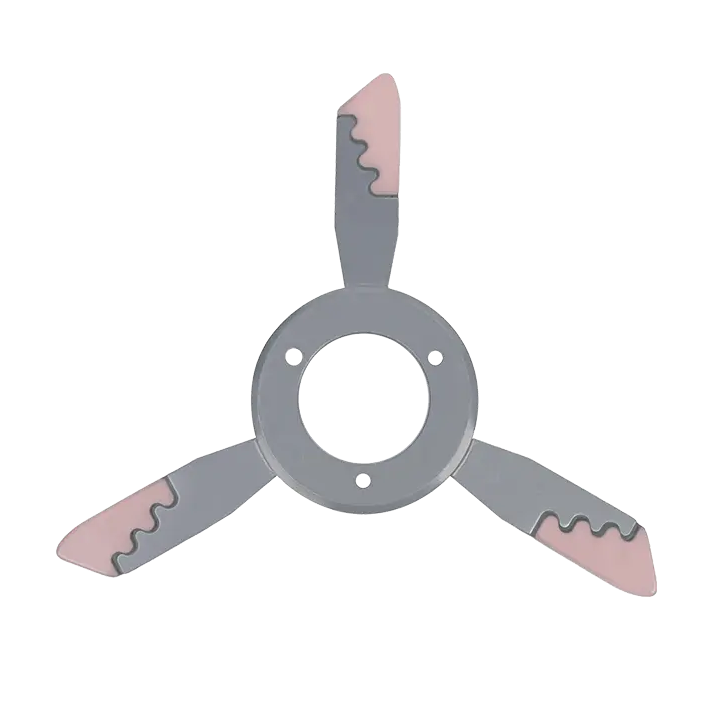
Even the best-maintained second-hand spinning machine relies on consumables and wear parts. Before committing to a legacy Barmag, TMT, or Chinese spinning line, confirm that the supplier maintains immediate stock of critical spares—including shift forks, chuck sleeves, lock rings, tension blocks, ceramic yarn guides, and hot godet bearings. Suppliers holding thousands of SKUs in ready inventory eliminate multi-month OEM backorders.
Assess Electrical & Control Modernization
Mechanical frames on German and Japanese spinning machines easily last 20 to 30 years, whereas legacy inverters, PLC boards, and HMI panels often become obsolete. Prioritize reconditioned units whose electrical cabinets have been upgraded with modern, globally supported drives and control modules, ensuring local maintenance teams can troubleshoot faults without proprietary OEM lockouts.
Demand Pre-Shipment Spinning Trials
Whenever introducing a new polymer formulation (such as fine-denier FDY, bicomponent yarn, or rPET) onto pre-owned equipment, validate process parameters in a pilot spinning laboratory prior to shipment. Testing actual polymer chips on pilot lines confirms denier CV%, breaking tenacity, and boiling water shrinkage before full-scale installation.
Evaluate Turnkey Engineering & Commissioning Support
Integrating used modules into an existing factory often involves modifying ducting, biphenyl piping, and building heights. Select a partner capable of providing complete layout engineering, on-site mechanical installation, electrical synchronization, and operator training.
5. Common Operational Faults and Troubleshooting Guide
During commissioning and steady-state operation of a reconditioned melt spinning line, operators frequently encounter specific mechanical or process anomalies. Rapid root-cause identification minimizes waste yarn and spindle downtime:
- High Filament Breakage Rate at Winding:
Root Causes: Worn plasma coating on hot godet shells causing micro-snagging; misaligned ceramic yarn guide plates; improper spin finish concentration; or degraded polymer IV due to dryer dew-point drift.
Corrective Action: Inspect godet surface roughness and re-coat damaged shells; verify yarn path alignment from quench exit to winder traverse; check dryer regeneration cycles and polymer moisture content. - Winder Vibration & Poor Bobbin Build (Ribbing / Bulging Edges):
Root Causes: Chuck shaft unbalance; worn spindle bearings; excessive clearance in the rotary traverse shift fork or gearbox; or incorrect contact pressure between the friction roller and bobbin.
Corrective Action: Perform dynamic re-balancing on the winder chuck assembly; replace worn shift forks (e.g., S-1011/S-1012 series) and lock rings; recalibrate traverse stroke reversal dwell times in the HMI. - Uneven Dyeing (Barre Effect) Across Spinning Positions:
Root Causes: Temperature gradient across hot godet surfaces exceeding ±1.5°C; uneven quench air velocity between adjacent positions; or worn metering pump gears causing denier variance.
Corrective Action: Calibrate godet induction heaters using precision contact pyrometers; clean quench air rectifier screens; bench-test metering pump output uniformity and replace worn pump plates. - Rapid Spinning Pack Pressure Rise:
Root Causes: Gel formation from thermal degradation in dead zones of the extruder or spinning beam; oxidized polymer flakes (common in rPET); or clogged sintered metal filter media.
Corrective Action: Flush dead zones during polymer changeover; verify nitrogen blanketing on PA lines; optimize filter mesh micron rating and pre-filter performance.
Conclusion: Maximizing ROI Through Engineered Reconditioning
Deploying a second-hand spinning machine allows chemical fiber manufacturers to capture market demand rapidly without over-leveraging capital budgets. By focusing on verifiable mechanical tolerances—such as dynamic chuck balancing, plasma-coated godet restoration, and precision temperature calibration—mills can achieve yarn quality indistinguishable from new OEM installations while securing long-term spare parts support.
Looking to source reconditioned Barmag ACW winders, hot godets, or complete POY/FDY melt spinning lines backed by over 6,000 in-stock spare parts and in-house pilot testing? Contact Jiaxing Shengbang Mechanical Equipment Co., Ltd. to discuss your line specifications and request an engineering evaluation.